In an era when silence is the easiest choice, some women choose to stand even if the cost is heavy.
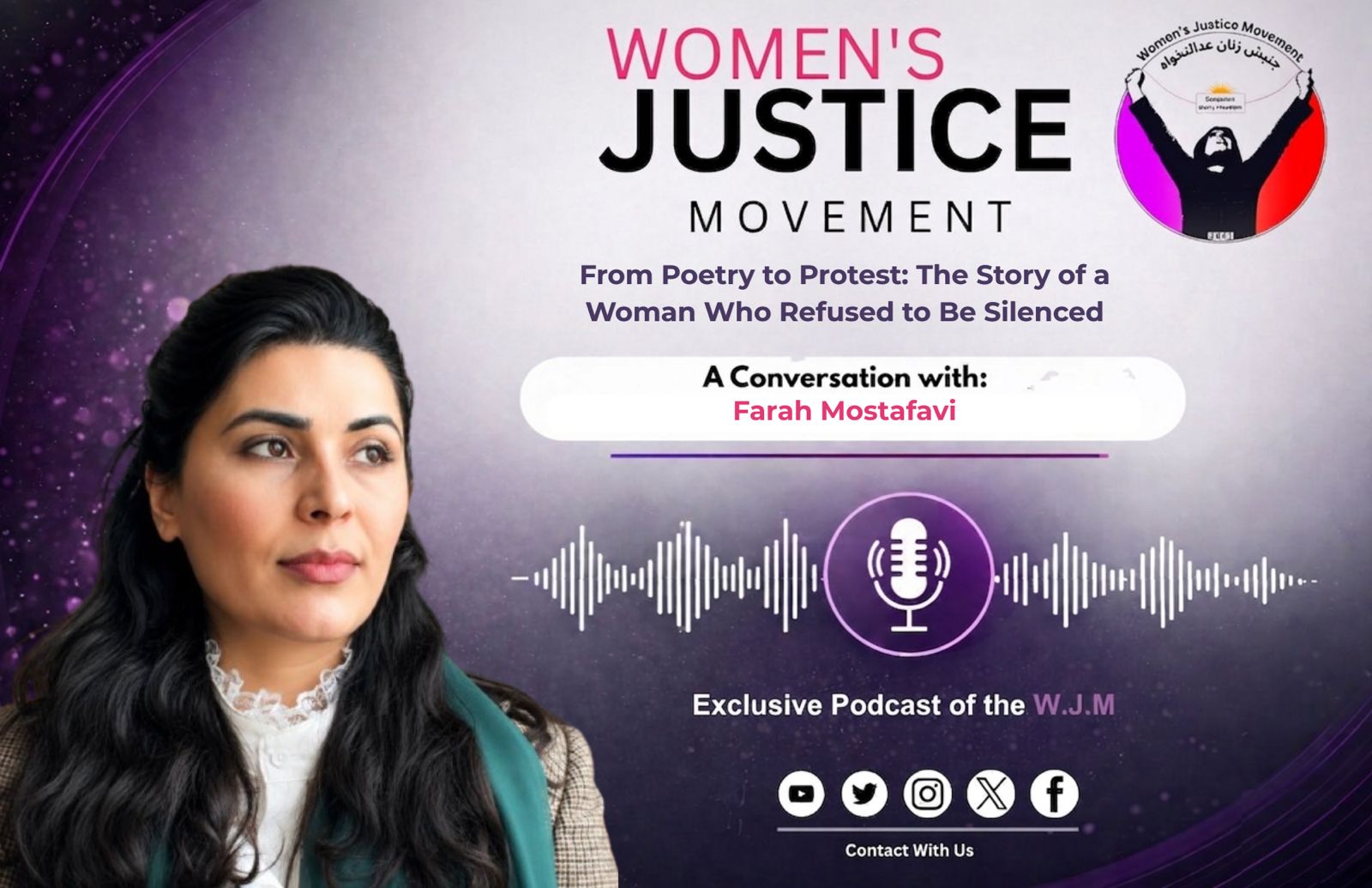
Farah Naz Mostafavi is one of those voices. She is a woman who stepped from the alleys of Faizabad, from walking to school barefoot, and from childhood poems and literary circles, into the gravest arenas of life. Raised in a family devoted to knowledge, she carved her path through literature, politics, social activism, and civil protest.
Her presence in the 2021 Kabul protests marked a turning point in her life a moment where poetry ceased to be mere words and transformed into a cry. Today, Farah is not just a poet; as a protesting woman and women's rights activist, she narrates the story of a generation that has chosen the path of resistance between fear and hope.
In this conversation, we delve into her experiences with poetry, politics, protest, and living as a woman in today's complex reality.
WJM: Please introduce yourself to the audience of the Justice-Seeking Women’s Movement website, in the way you would most like to be known.
Farah: I would like to be known not merely as a poet, a political activist, or a protester, but as a human being who has tried to preserve the act of "thinking" in an era where everything invites human beings to obey, repeat, and remain silent.
In our world, evil does not always appear in the guise of a monster; sometimes it enters our lives in the form of habit, everyday obedience, and the gradual acceptance of human erasure. Perhaps this is the very experience of Afghanistan—a land where people have been gradually conditioned to the absence of freedom, the absence of a state, and even the absence of truth.
If there is anything that defines me, it is perhaps this struggle to resist the "normalization of darkness." I believe that as long as a human being retains the capacity to question and to think, they are not yet completely defeated.
WJM: You transitioned from the realms of poetry, culture, and politics to the streets of protest. What triggered this shift in your life, and what was your role in the spontaneous women's movement?
Farah: In times of crisis, no boundary remains between poetry, politics, and life. When reality becomes so brutal that even breathing takes on a political color, silence is no longer neutrality; it becomes a form of collaboration with the status quo.
For me, the street was the natural continuation of writing. A person takes to the street when official language is no longer capable of explaining their suffering. The return of the Taliban was not just a change of government; it was a moment when it suddenly became clear how quickly a society could be emptied of its public space, and how human beings, particularly women, could be stripped of their right to exist in it.
In the spontaneous women's movement, my role was mostly an effort to transform scattered fear into collective awareness. Tyranny always tries to isolate individuals, because a solitary human being surrenders much faster. We were trying to revive the concept of "togetherness," even if that togetherness lasted for only a few minutes of standing on a street corner.
WJM: Was participating in the 2021 Kabul protests a choice for you, or a necessity?
Farah: At certain historical moments, a human being is no longer free to remain a mere spectator. That moment, for me, was a moral necessity.
When power attempts to erase a group of human beings from the public sphere, silence is no longer just silence; it becomes the acceptance of that erasure. I believe that when faced with injustice, before being responsible for changing the world, a human being is responsible for preserving their own humanity.
Taking to the streets might not have brought about immediate change, but not going meant accepting that a woman could be erased from the world while everything else continued as normal.
WJM: As a protesting woman, what was your first encounter with fear on the streets? And if you could go back to 2021, would you take to the streets again?
Farah: The fear, before being a fear of death, was a fear of the world becoming meaningless. In totalitarian regimes, humans do not just fear violence; they fear that truth will no longer have a place to manifest.
When I stood on the street for the first time, I felt that we were standing not just against the Taliban, but against a massive machinery of erasure a machine that wanted to wipe women out of the social memory.
If I could go back to 2021, I would take to the streets again. Because in certain moments, acting even if it ends in failure is more ethical than silence. Humans do not always fight for victory; sometimes they fight simply to prove that they are still human.
WJM: Is protest, for you, more of a political act or a human cry?
Farah: Every true protest, before being political, is a defense of human dignity. Politics becomes dangerous when it reduces human beings to tools, and totalitarianism begins precisely there—the moment an individual is no longer seen as a human, but defined merely as an erasable object.
The protest of Afghan women, in its deepest sense, was the return of the human being to the public sphere. They wanted to say: "We are still here." And sometimes, this simple sentence is the greatest threat to any repressive regime.
But for me, it wasn’t only those holding weapons who were terrifying. Those who stood by, watching in silence as humans were erased, represented another kind of horror. Evil does not always manifest in the face of the executioner; sometimes it appears in people who have become so accustomed to fear that they can no longer see their own chains.
To quote Bedil: "From their breath came the sound of chains" the chains of their own captivity in the hands of another. And perhaps that is the most sorrowful moment for a society: when a human being loses not just their freedom, but even the awareness of their own captivity.
WJM: Following the 2021 protests, how did your activism in the field of women's rights continue, and what kind of work are you engaged in now?
Farah: After the relative silencing of the streets, the struggle entered another phase: the phase of preserving memory. Tyranny does not just imprison bodies; it attempts to destroy narratives so that later, no one can recount the truth.
My work shifted more toward writing, analysis, documentation, and building a bridge between the lived experiences of Afghan women and the global language of rights and politics. I believe that one of our most important responsibilities today is to prevent this era from being forgotten.
When the world grows accustomed to suffering, the most dangerous phase begins, because crime is no longer an exceptio it becomes part of the daily order.
WJM: As an active member of the "Kabul Critical School," how do you define this movement? Does it have a specific structure or leadership, and what is its objective?
Farah: The Kabul Critical School should be understood primarily as an effort to bring "critical thinking" back to a society that has been trapped for years between ideology, war, and power.
In Afghanistan, we are not just facing a political crisis; we are facing a crisis of thought. Many power structures—whether religious, ethnic, or political—do not want human beings to think; they only want them to obey.
The goal of this movement is to create a space for questioning, doubting, and rethinking concepts such as the state, the nation, womanhood, freedom, and power. In appearance, this may seem like a small task, but every autocratic regime fears the questioning human being above all else.
WJM: In your opinion, what was the most important demand of the protesting women at that time that still remains unanswered?
Farah: The most important demand was the right to exist in the world. Afghan women did not protest merely for the right to work or education; they rose up against being rendered invisible. Totalitarianism always seeks to erase a group of humans from the public eye, as if they never existed.
The demand of the women was to be recognized as complete human beings, not as entities defined by patriarchal power. And this demand remains unanswered, because the ruling structure still views woman not as a subject, but as an object of control.
WJM: You studied politics. Was the reality of the protest field different from what you read in books?
Farah: Yes, because books can explain power, but they cannot describe the profound loneliness of a human being standing in the face of violence.
In theory, politics is often a collection of rational concepts; but on the street, politics transforms into an existential experience. It was there that I realized freedom is not an abstract concept; it is the simple possibility of being present and speaking in the world.
And perhaps most importantly, I learned that evil does not always stem from deep hatred; sometimes it flows from blind obedience and the inability of humans to think.
WJM: In a society where protest carries such a heavy cost, what drives you to keep going?
Farah: Because silence also destroys a human being. If a person lives for a long time contrary to the truth they see, they gradually lose their connection with themselves.
Continuing, for me, is less about the hope for an immediate victory and more about an effort to maintain a relationship with the truth. Sometimes resistance is simply not allowing the lie to completely replace reality.
WJM: As a women's rights activist, what do you see as the greatest obstacle facing women in Afghan society today? And what is your message to the women reading this interview right now?
Farah: The greatest danger is not just the Taliban; it is the gradual normalization of the erasure of women. Any repressive regime becomes powerful when the public becomes accustomed to an inhumane situation and accepts it as a natural part of life. If society adapts to the absence of women in the public sphere, then their complete erasure becomes far easier.
My message to the women of Afghanistan is this: even if the world does not hear your voice, your experience is real. Do not let anyone deny your suffering, your memory, or the meaning of your existence. Every woman who still thinks, writes, protests, or even in silence refuses to forget the truth, is a part of the resistance.
WJM: Today, amidst all these experiences—poetry, politics, and protest—how does Farah Mostafavi view herself most: as a poet, a politician, a women's rights activist, or a protester?
Farah: Perhaps none of them alone is enough. I see myself more as a human being who has tried, in a time of collapse, to preserve the capacity to think and to bear witness.
Poetry, politics, and protest are, for me, different forms of a single responsibility: responsibility toward the truth. Perhaps in the end, the most important task of a human being is to prevent the world from completely turning into a place without memory and without meaning.
WJM: If there is any point, experience, or message that was not raised in this conversation but is important to you, please share it with us and the audience of the Justice-Seeking Women's Movement.
Farah: The greatest danger for Afghanistan is not just violence; it is amnesia. Tyranny wins when its victims are not only suppressed, but also erased from the memory of history.
The women of Afghanistan today are not just fighting for their individual rights; they are fighting to preserve the possibility of being human in a society that has lived for decades under the shadow of war, fear, and power. And perhaps hope, in such an era, is not a naive optimism, but this very persistence upon the truth—even when everything invites the human being to remain silent.
Farah Naz Mostafavi is not just a name among protesting women; she is the narrative of a generation that, caught between restrictions and dreams, chose to stand.
From poetry to the streets, from words to cries, her journey shows that sometimes words are not enough—and the human being themselves must become the voice. This conversation is not just the review of a life; it is a glimpse into the meaning of resistance, the voice of a woman, and a hope that refuses to die out, even in the darkest of days.
Interviewer: Zarifa Salangi
Share: